
Cavity Wall Insulation
Introduction
Most cavity walls, especially those in properties built after 1930, can be filled.
The work usually takes about half a day and there is no need for the occupants to leave the house whilst the work is in progress.
The decision on whether a wall is suitable for filling depends on:
- The exposure of the wall to driving rain
- The pointing of the masonry outer leaf
- The type of insulation material
- The masonry material itself
Suitability inspection
It is essential that all walls are inspected prior to installation to assess their suitability. All defects and dampness penetration problems must be addressed before starting the work. Walls with cavities less than 50mm wide are not suitable for insulation and any PVC covered electrical cables should have been removed.
Materials used
The three most common types of cavity wall insulation used are:
- Blown mineral fibre
- Polystyrene beads or granules
- Urea formaldehyde foam
1. Blown Mineral Fibre
Blown mineral fibre consists of strands of fibreglass or mineral wool that are forced into the cavity using compressed air. This material can be used in any part of the country and is covered by British Board of Agrement (BBA) certificates. For further information on British Board of Agrement Certificates, visit the BBA Certification website (external link).
2. Polystyrene beads or granules
Polystyrene beads may be supplied loose or in a light sticky resin to hold them together. Polystyrene granules will stick together of their own accord due to their rough shape. Both types of material are blown into the cavity using compressed air. Again, both types of materials are covered by British Board of Agrement (BBA) certificates.
3. Urea Formaldehyde Foam
Urea formaldehyde foam is created within the wall cavity by injecting and simultaneously mixing two chemical components to form the foam which then expands to fill the cavity. This type of insulation is covered by British Standards BS:5618 for the material and BS5617 for the application.
Installation procedure
The installation of cavity wall insulation must be carried out by a specialist contractor, who should provide a Cavity Insulation Guarantee Agency (CIGA) guarantee which is the industry wide guarantee scheme for this type of work. For further information, visit the Cavity Insulation Guarantee Agency - CIGA website (external link).
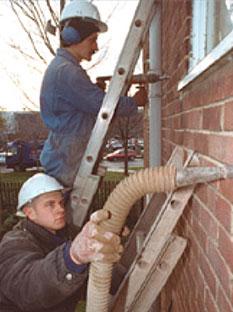 In a typical installation small holes are drilled into the mortar between the brick courses of the outer leaf at approximately one metre intervals. The insulating material is blown or injected into the cavity through these holes which are subsequently filled to leave no sign of the work that has been carried out.
If re-plastering of the internal walls is planned then it may be preferable to inject the insulation material through holes drilled in the internal walls, which are then covered when the wall is plastered.
Further information
'Energy Efficiency Best Practice in Housing' publications provide information and advice on all aspects of energy efficiency in domestic dwellings. These can be obtained free of charge by calling 0845 120 7799 or visiting the Energy Saving Trust website (external link).
The four publications concerned with cavity wall insulation are:
- GPG26: Cavity Wall Insulation in Existing Housing
- GPG155: Energy Efficient Refurbishment of Existing Housing
- GIL 23: Cavity Wall Insulation - unlocking the potential in existing dwellings
- CE57: Refurbishing cavity wall dwellings
| Filename | Filetype | Size |
|---|---|---|
| GIL 23: Cavity Wall Insulation | 465.75 KB |